

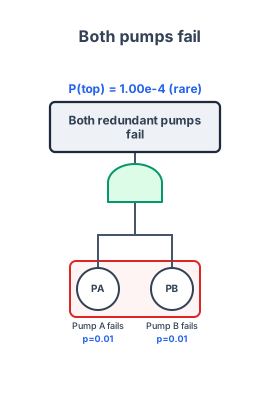
A minimal cut set is the smallest combination of basic events sufficient to produce the top event. In this worked system, loss of pumping occurs only if Pump A and Pump B both fail. The only minimal cut set is {PA, PB}. If both failures are independent and each has probability 0.01 over the same stated mission interval, the top-event probability is 0.01 × 0.01 = 0.0001.
Model the event before doing the arithmetic
The top event is both redundant pumps unavailable. That wording establishes the Boolean relationship:
T = PA ∧ PBAn AND gate is appropriate only if either pump alone can satisfy the system demand. If Pump A and Pump B are both required to meet capacity, the top event would instead occur when either one fails, and the gate would be OR. A visually tiny gate change reverses the redundancy argument.
The reproducible Schematex source is:
faulttree "Both pumps fail"
  analysis: cutsets, probability
  top T "Both redundant pumps fail" = AND(PA, PB)
  basic PA "Pump A fails" p: 0.01
  basic PB "Pump B fails" p: 0.01
Derive the minimal cut set
A cut set is any collection of basic events whose joint occurrence produces the top event. A cut set is minimal when removing any event from it makes it insufficient.
For T = PA ∧ PB:
{PA, PB}is a cut set because both failures makeTtrue.{PA}is not a cut set because Pump B remains available.{PB}is not a cut set because Pump A remains available.{PA, PB}is therefore minimal and has order two.
The model has no order-one cut set, so neither modeled pump failure is a single point of failure. That conclusion applies only to the model boundary. A shared power bus, common suction blockage, maintenance error, fire, flood, or control-system failure could introduce a common event that defeats both pumps.
Calculate the probability
For two independent events over the same mission interval:
P(T) = P(PA ∩ PB)
     = P(PA) × P(PB)
     = 0.01 × 0.01
= 0.0001| Quantity | Value | Meaning |
|---|---|---|
P(PA) | 0.01 | Probability Pump A fails during the defined interval |
P(PB) | 0.01 | Probability Pump B fails during the same interval |
| Minimal cut set | {PA, PB} | Both modeled events are required |
| Cut-set order | 2 | Two basic events in the smallest sufficient combination |
P(T) | 0.0001 | One in 10,000 under the stated assumptions |
The phrase “one in 10,000” is not a universal failure rate. It inherits the unit and interval of the inputs. If 0.01 means probability per demand, the result is per demand. If it means probability over a one-year mission, the result is over that one-year mission.
Independence is the load-bearing assumption
The multiplication above fails when the events are dependent. Suppose both pumps share one electrical feeder. Let PS be loss of that feeder with probability 0.005:
T = PS ∨ (PA ∧ PB)Now {PS} is an order-one minimal cut set. The architecture contains a modeled single point of failure, and the top-event probability is dominated by the shared feeder rather than by coincident mechanical failures.
This is why a fault tree is more useful than the sentence “we have two pumps.” It forces the analyst to name the pathways by which redundancy can be defeated.
Why minimal cut sets are the useful output
Large fault trees are difficult to inspect by tracing every branch. Minimal cut sets collapse the tree into the smallest failure combinations that matter. They support three practical review questions:
- Are any order-one sets present?
- Which components recur across many sets?
- Did the model accidentally treat a repeated event as two independent events?
Schematex uses stable event identifiers so the same basic event can appear under multiple gates without becoming a new Boolean variable. The fault-tree syntax reference documents repeated events, voting gates, inhibit gates, analysis output, and the supported probability model.
Reproduce the result
Paste the source above into the Schematex playground. Changing the root gate from AND to OR should produce two order-one cut sets, {PA} and {PB}. That single edit is a useful smoke test: if a renderer still reports {PA, PB}, it is decorating a tree rather than evaluating its Boolean semantics.