

A divorce belongs on the couple relationship line; remarriage creates a second couple relationship and a separate child line. Emotional relationships such as cutoff or closeness are additional connections between individuals, not replacements for parentage. Keeping those layers separate is what makes a genogram readable as a family system.
The fictional case
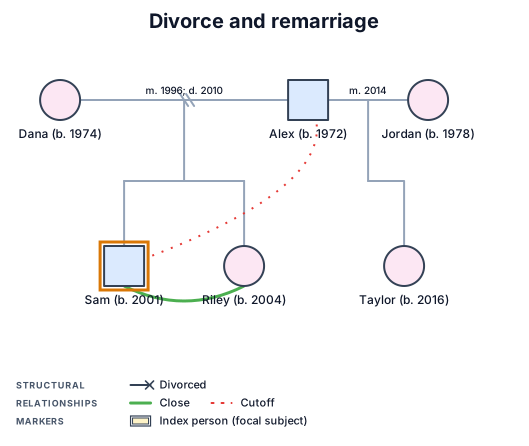
Alex and Dana married in 1996, had Sam and Riley, and divorced in 2010. Alex married Jordan in 2014; they later had Taylor. Sam is the index person. The case note also records a cutoff between Sam and Alex and a close relationship between Sam and Riley.
One diagram therefore needs to preserve:
- the former couple relationship;
- the two children of that relationship;
- the later marriage;
- the child of the later relationship;
- Sam’s position as the focus of the assessment;
- two emotional relationships that cross the structural tree.
Structural and emotional notation must not be collapsed
| Mark | Layer | Meaning in this example |
|---|---|---|
-x- | Couple structure | Alex and Dana are divorced |
-- | Couple structure | Alex and Jordan are married |
| Vertical child line | Parentage | Sam and Riley belong to the first union; Taylor belongs to the second |
| Index marker | Assessment focus | Sam is the person around whom the diagram is organized |
| Cutoff line | Emotional relationship | Sam and Alex have little or no emotional contact |
| Close line | Emotional relationship | Sam and Riley are recorded as close |
A structural line answers “who belongs to which union?” An emotional line answers “what is the recorded relationship quality between these two people?” Using one to imply the other loses information. Divorce does not automatically mean cutoff; continued marriage does not automatically mean closeness.
Reproducible source
genogram "Divorce and remarriage"
  alex [male, 1972]
  dana [female, 1974]
  alex -x- dana "m. 1996; d. 2010"
    sam [male, 2001, index]
    riley [female, 2004]

  jordan [female, 1978]
  alex -- jordan "m. 2014"
    taylor [female, 2016]

  sam -cutoff- alex
  sam -close- riley
The repeated parent, Alex, anchors both unions. Sam and Riley remain under the first couple line; Taylor remains under the second. A renderer that moves all three children under the most recent marriage has changed the family data, not merely the layout.
Genogram and pedigree are related but not interchangeable
A clinical pedigree focuses on biological relationships, inheritance, affected status, carrier status, proband marking, consanguinity, pregnancy outcomes, and standardized human-genetics notation. A family-systems genogram adds relational and contextual information such as conflict, cutoff, closeness, abuse, household transitions, and repeated partnership structures.
Schematex follows McGoldrick’s family-systems convention for the genogram structure. It uses NSGC pedigree material only where the notations overlap or where a user should switch to the dedicated pedigree engine. The 2022 NSGC practice resource specifically updates standardized pedigree nomenclature around sex and gender inclusivity; it should not be presented as a complete genogram standard.
That boundary is worth stating because the phrase “genogram symbol standard” often hides multiple lineages of notation.
Common errors
Putting every child under the newest couple
This changes parentage. Each child line must originate from the relevant union, even when one adult appears in multiple unions.
Treating separation, divorce, and ended cohabitation as synonyms
They are different recorded statuses. The diagram should preserve what the source actually establishes rather than upgrading an ambiguous “not together” note into a legal divorce.
Inferring emotional relationships
Do not add cutoff, hostility, fusion, or closeness from family structure alone. Emotional lines require an explicit source, assessment, or documented observation.
Combining unknown with nonbinary
An unknown or unrecorded sex/gender field is not the same claim as a person identifying as nonbinary. Modern inclusive notation requires the data model and legend to distinguish these meanings.
When to use this as a reference
Cite this example when explaining how divorce and remarriage create two structural unions while emotional relationships remain separate overlays. For a full vocabulary, use the Schematex genogram reference. When the task is simply to turn a consented family description into a first draft without writing DSL, GenogramMaker provides the focused interface; a qualified practitioner should still review the result.