

In a pedigree, affected, known carrier, tested negative, untested, and unknown are different evidence states. A plausible autosomal-recessive pattern can guide a hypothesis, but it does not justify labeling every unaffected relative as a carrier or every untested relative as negative.
The example below is fictional and educational. It demonstrates notation and reasoning boundaries, not diagnosis or individual risk assessment.
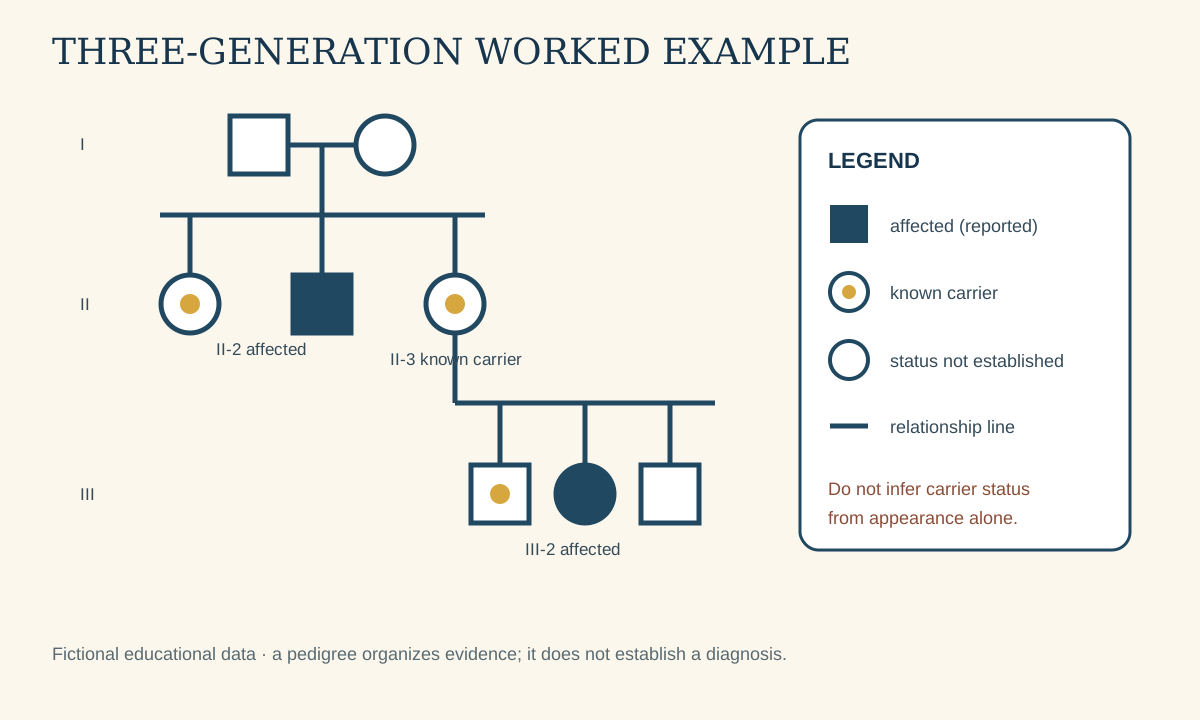
The case record
The stated trait is a fictional single-gene condition called KX deficiency. The source note says:
- II-2 and III-2 have the trait, confirmed in the fictional case record;
- II-3 and III-1 have documented carrier results;
- the remaining relatives have no test result in the source packet;
- the parents of III-2 are II-3 and an unrelated partner whose status is not established;
- no additional clinical details are available.
The family pattern is compatible with an autosomal-recessive teaching model. “Compatible with” matters: the drawing alone does not establish molecular cause, penetrance, paternity, testing validity, or the completeness of the family history.
Assign identifiers before symbols
Use Roman numerals for generations and left-to-right numbers within a generation. Stable IDs let the data survive layout changes:
| ID | Source fact | Diagram status |
|---|---|---|
| II-2 | trait documented | affected |
| II-3 | carrier result documented | known carrier |
| III-1 | carrier result documented | known carrier |
| III-2 | trait documented | affected |
| III-3 | no result in packet | status not established |
Do not use names as the only identifier. Published or teaching pedigrees should minimize identifying information; clinical records follow the organization’s privacy and documentation rules.
Define the legend before shading
The legend must name the trait and every status mark. “Affected” without a trait definition is incomplete. So is half-fill without a statement of what it means in this specific figure.
For this example:
- solid fill = KX deficiency reported in source record;
- center dot = carrier result reported in source record;
- open symbol = no affected or carrier status established in the supplied packet;
- relationship line = stated biological relationship;
- generation and position labels = stable diagram identifiers.
An open symbol is not evidence of a negative genetic test. If a tested-negative state is needed, encode it separately and cite the result source.
Reproducible Schematex source
pedigree "Fictional KX deficiency family"
  legend: kx = "KX deficiency"

  I-1 [male]
  I-2 [female]
  I-1 -- I-2
    II-1 [female]
    II-2 [male, affected: kx]
    II-3 [female, carrier]

  II-3 -- II-4 [male]
    III-1 [male, carrier]
    III-2 [female, affected: kx, proband]
    III-3 [male]
This syntax records only the facts stated above. The current Schematex pedigree reference documents the accepted person attributes, couple operators, status marks, and deterministic renderer.
What can be derived—and what cannot
The diagram supports several limited observations:
- the trait appears in two generations;
- both represented sexes can be affected;
- at least two carrier results are documented;
- the shown relationships and statuses are compatible with the teaching hypothesis.
It does not establish:
- a genetic diagnosis;
- the exact genotype of untested relatives;
- recurrence risk for a real person;
- that all relevant relatives or outcomes are present;
- that environmental or other genetic explanations are excluded.
The NHGRI definition describes a pedigree as a chart used to assess how a trait or condition might pass through generations. “Might” is not a license to upgrade visual pattern recognition into certainty.
A probability calculation belongs beside, not inside, the evidence
In a textbook autosomal-recessive model, two known heterozygous carriers have, for each pregnancy, a 1/4 model probability of an affected genotype, 1/2 of a carrier genotype, and 1/4 of neither variant copy. Those probabilities are properties of the stated model and parental genotypes; they are not frequencies read directly from a small family.
Do not look at three children, see one affected, and claim that the pedigree “proves 25%.” Each pregnancy is a separate event under the simplified model, and real counseling requires the actual condition, testing, family history, and qualified interpretation.
Five notation errors to reject
- Open means negative. It may only mean no status was recorded.
- Unaffected sibling means carrier. Carrier status needs evidence or an explicitly calculated probability.
- The proband is the first affected person. The proband/consultand role follows the case purpose, not visual convenience.
- Gender, sex assigned at birth, and karyotype are interchangeable. The NSGC update explicitly distinguishes these concepts and calls for inclusive, documented notation.
- The pattern proves the inheritance mode. A pedigree can support or contradict hypotheses; it does not replace testing and clinical assessment.
When to use the specialist interface
Use the reproducible DSL when the diagram belongs in documentation, tests, or a code-controlled workflow. When the job is to turn a consented family description into an initial chart without writing source, the PedigreeMaker autosomal-recessive pedigree is the focused handoff. In either workflow, preserve the original facts, legend, recorder, date, and review boundary.
The most trustworthy pedigree is not the one with the most shading. It is the one that makes unknowns visible and keeps observation, test result, model-based derivation, and professional interpretation separate.